
















How to Apply Makeup Primer Before Foundation
See where to place primer and how to layer it under liquid or powder foundation.
Apply makeup primer after moisturiser and sunscreen and before foundation. Let your sunscreen settle, spread a thin layer of primer with clean fingertips or a sponge, and wait until the finish feels even before applying foundation. Use primer across your face if you want the same finish everywhere, or apply it only where you want less shine, smoother-looking texture, or colour correction.
If you’re learning how to apply makeup primer, start with the area where your base usually gives you trouble. A shiny nose may need an oil-control primer, while dry cheeks may benefit from a moisturising base. When redness is concentrated around the nostrils, a little blue-green primer may be enough. Here’s how to use five Japanese makeup bases from Japan Standards.
How to Apply Face Primer Step by Step
1. Let Your Skincare and Sunscreen Settle
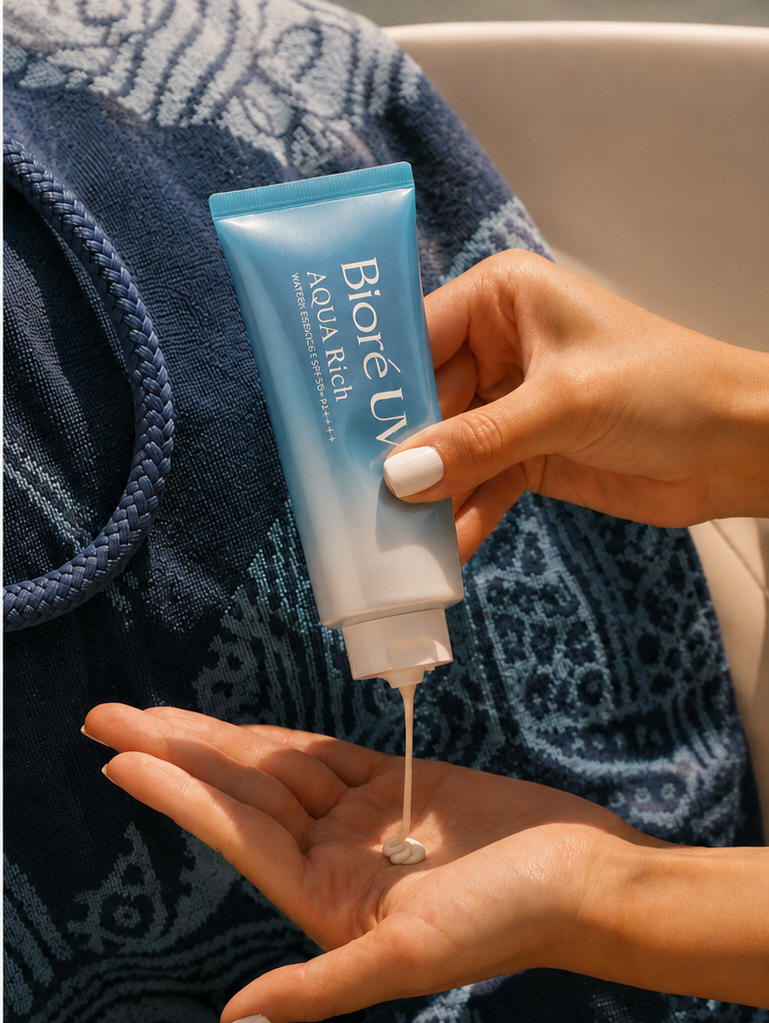
Apply your usual moisturiser and let the surface settle. For daytime wear, apply broad-spectrum sunscreen according to its label. Once it has formed an even layer, use gentle pressure to add primer. If you use a sunscreen-primer hybrid, such as CANMAKE Mermaid Skin Gel UV, follow its sunscreen directions and then move on to foundation when the gel settles.
Check the finish of your sunscreen first
Some sunscreens already leave a smooth finish that works well under foundation. Try applying foundation over your usual sunscreen on one side of your face and adding primer on the other. Keep the amount of foundation the same on both sides. Check again after a few hours to see where the extra layer changes how your makeup wears.
2. Apply a Thin Layer Where You Want It
Follow your primer’s directions for the amount. For a standard makeup base, start with a small amount and spread it evenly. When applying it all over, dot it across the forehead, nose, chin, and both cheeks before blending outward. For targeted application, start with a small dab on the area you want to prime.
Should you use fingers or a sponge?
Clean fingertips make it easy to control the amount beside the nose and on the inner cheeks. A clean sponge can help you press a thin layer onto a wider area. Use gentle taps if rubbing tends to move the products underneath or make them roll into small bits.
Can you use two primers on different areas?
Yes. If your forehead gets shiny and your cheeks feel dry, try an oil-control primer through the T-zone and a hydrating primer on the cheeks. Blend where the areas meet so you have an even surface for foundation.
Keep the overlap thin
Check the inner cheeks and sides of the nose, where the two primers are most likely to meet. If there’s a visible ridge or a thicker patch, tap the edge flat before adding foundation.
3. Wait Until the Primer Is Ready for Foundation
There’s no fixed wait time for every formula. Follow the product directions and check the surface. If the primer still feels wet or slides under your fingertip, give it more time. A gripping primer may retain some tack by design. With that formula, look for an even layer that stays in place when you start blending makeup.
How to apply liquid foundation over primer
Start at the centre of the face and work outward. Pat foundation over areas where you’ve applied a correcting tint so the colour stays where you put it. If you use a brush, finish with light strokes and check the sides of the nose and the jawline for edges.
How to use primer with powder foundation
Let the primer settle before applying powder foundation. Lightly press the powder onto the skin with a puff or use a brush for a sheerer finish. If powder catches in one spot, check whether the primer there is still damp or thicker than the surrounding layer.
Where to Put Makeup Primer
| What you want to change | Where to apply it | Primer to compare |
|---|---|---|
| Midday shine | Forehead, nose, or chin | CEZANNE Sebum Control Light Blue |
| Visible pores or uneven texture | Inner cheeks and around the nose | Clé de Peau Beauté Voile Correcteur |
| Dry-looking skin with visible redness | Across the face as directed | KANSOSAN Cica Green |
| A lightweight sunscreen base | Evenly over exposed skin as directed | CANMAKE Mermaid Skin Gel UV |
| Visible redness | Check how the tint blends beside the nose or on flushed cheeks | d program CC Blue Green |
Choose placement based on how your makeup wears
A mattifying primer can be useful on a shiny T-zone even when you prefer a natural sheen on the cheeks. A smoothing primer can go where pores or texture are most visible under foundation. If you have combination skin and want to keep your routine simple, try one lightweight primer on the area where foundation wears away first. Best Makeup Primer for Oily Skin: Japanese Options
Five Japanese Primers and How to Apply Them

CEZANNE Sebum Control Foundation Light Blue 30ml
A light blue makeup base with sebum-absorbing powder.
Choose this makeup base if shine is your main concern. CEZANNE uses sebum-absorbing powder in this formula. Start on the forehead and nose, then decide whether your chin needs it too. Let the light blue tint settle and check it in daylight, especially if you plan to wear a sheer foundation. Shop CEZANNE Sebum Control Light Blue

Clé de Peau Beauté Voile Correcteur 40g
A cream primer for a smoother-looking finish beneath foundation.
Choose this cream primer if you want a smoother-looking finish across your face. Apply a small amount to the forehead, nose, chin, and both cheeks, then smooth it evenly. Wait until it feels set before applying foundation. If texture is most visible on your inner cheeks, check those areas after both layers are on to see how much coverage you still want. Shop Clé de Peau Beauté Voile Correcteur

KANSOSAN Moisturizing Skin Care Primer Cica Green 30g
A moisturising green-tinted base labelled SPF45 PA+++.
Choose Cica Green if you want a moisturising base with a green tint. Follow the directions for all-over application and blend evenly around the jaw and hairline. The formula is labelled SPF45 PA+++. If you already wear a separate sunscreen, let it settle before layering this primer, then check whether the two layers stay smooth around your nose and mouth. Shop KANSOSAN Cica Green Primer

CANMAKE Mermaid Skin Gel UV 40g
A watery SPF50+ PA++++ gel that doubles as a makeup base.
Choose this gel if you want a sunscreen that doubles as a makeup base. It’s labelled SPF50+ PA++++ and spreads to a watery texture. Apply it evenly according to the sunscreen directions, then give it time to settle before blending foundation. If your foundation already goes on evenly over the gel, you can skip the extra primer step. Shop CANMAKE Mermaid Skin Gel UV

d program Medicated Skin Care Base CC Blue Green 25g
A blue-green makeup base for redness around the nose or cheeks.
Choose Blue Green when visible redness is the colour you want to soften. Follow the product directions and take extra care blending beside the nostrils and along the edges of flushed areas. Check the blue-green tint in daylight before adding foundation. If you only want extra coverage over one mark, a little skin-toned concealer may be enough. Shop d program CC Blue Green
Why Primer Pills or Foundation Separates
If the products roll into little bits as you blend
Pilling can show up when layers are thick or when rubbing lifts a layer underneath. Let each layer settle and try using less primer. Keep using sunscreen in the amount its directions specify. If you still see little rolls, test one change at a time so you can tell which combination works better.
Test compatibility with the products you actually wear
Water-based and silicone-based labels can help you compare textures. Test the primer with your usual sunscreen and foundation to see how the full combination spreads and wears.
Try a half-face comparison
Apply the same skincare and foundation on both sides, with primer on one side. Check the result just after blending and again in the afternoon. Look at how the foundation wears around the nose, where shine and movement can make separation easier to see.
Check whether the pigment has shifted
If the coverage still looks even and you mainly see shine, blot gently before touching up. If the pigment has become patchy, try a thinner primer layer or a different pairing the next time you apply makeup.
Can You Wear Primer Without Foundation?
Yes. You can wear a face primer on its own if you like the finish or the effect of a correcting tint. A little spot concealer can cover any marks you still want to soften. Use eye primer on the eyelids before eyeshadow if that’s the area where you want more even wear. Setting spray goes on after makeup. For a closer look at what each type of face primer does, read What Is a Makeup Primer?
Related Makeup Primer Guides
Shop Japanese Makeup Primers
Explore Primer for oil-control, moisturising, and colour-correcting bases. Find a complexion product to wear over it in Foundation, or browse Face Makeup, Makeup, and Beauty for the rest of your routine.
Find a Primer for the Areas You Want to Prep
Compare bases for shine, texture, dry-looking skin, and visible redness.
Shop Japanese Makeup Primers →